
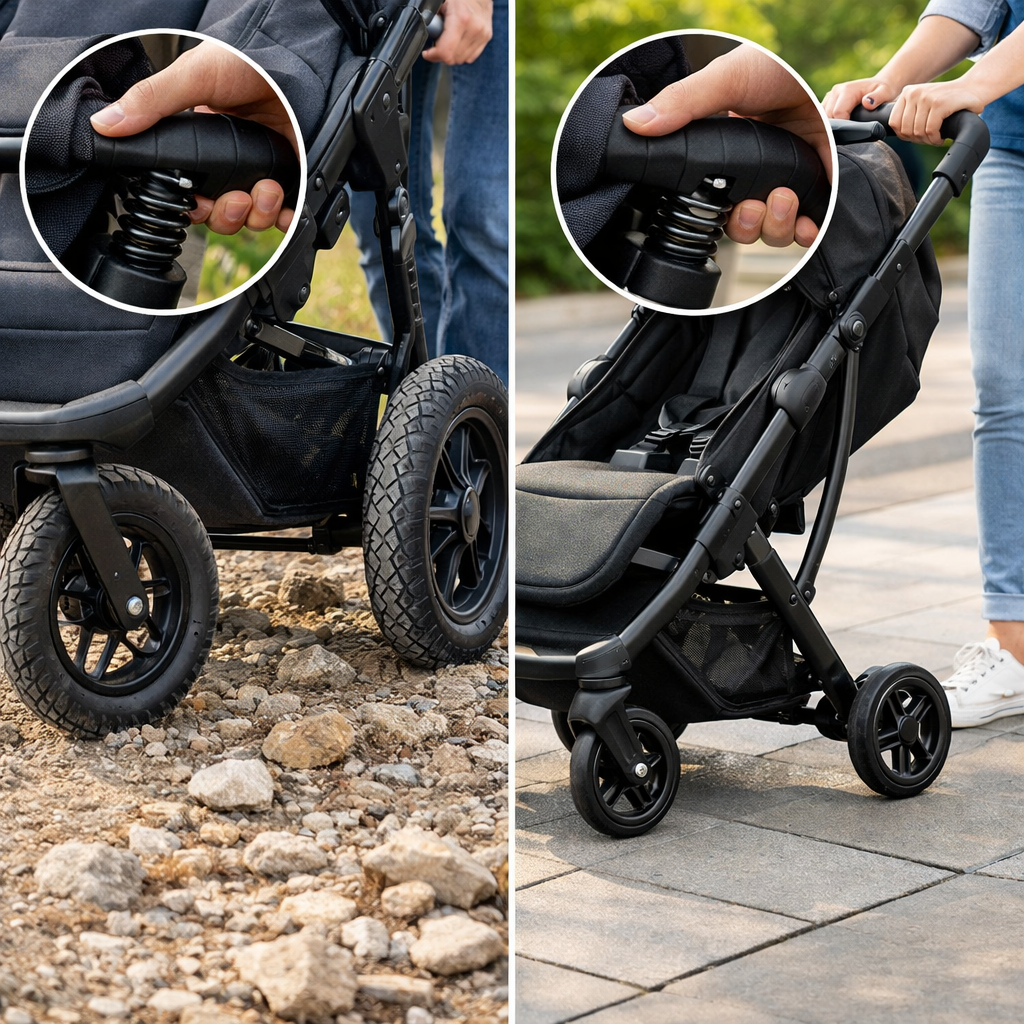
All-Terrain vs City Strollers: Which Suspension Feels Smoother?
A smooth stroller makes walks quieter, naps longer, and your wrists less sore. On rough or mixed terrain, all-terrain models with larger tires and more advanced suspension almost always feel smoother. On flat sidewalks and indoors, a lightweight city stroller can feel just as smooth—and far easier to maneuver and store. In this guide, we explain how suspension works, what wheel and frame choices change the ride, and how to pick the setup that matches 80% of your outings. We also share quick, real-life tests you can try in-store or at the park so you can feel smoothness for yourself. If naps on the go are a priority, focus on tires and suspension first; features come second.
What stroller suspension does and why it matters
Stroller suspension is the system of springs, shocks, and flexible joints designed to absorb impacts from uneven surfaces. By reducing vibration transferred from the wheels to the seat and handlebar, suspension helps keep the ride smooth for babies and more comfortable for the person pushing.
In practice, better suspension and the right tires mean fewer jolts over sidewalk seams, gravel, and grass—protecting your baby’s comfort and helping you push with one hand when you’re managing snacks or a coffee. All-terrain strollers typically pair advanced suspension with larger, treaded or air-filled tires; city strollers tend to have smaller wheels and basic suspension optimized for smooth sidewalks, tighter spaces, and frequent folding, as outlined in this overview of all-terrain vs. city designs from Bebelux Baby (All-terrain vs. city stroller traits).
Not every three-wheeled “all-terrain” model is a jogging stroller. Jogging strollers usually feature a large, fixed front wheel for stability at speed and often a hand brake for safety, distinctions emphasized by Consumer Reports (Jogging vs. all-terrain basics).
How we’ll compare smoothness
To keep “smoothness” objective, we look at:
- Surfaces: sidewalks, curbs, gravel, grass, and packed dirt.
- Features: wheel size and tire type, suspension design, frame weight, maneuverability, and price-to-performance.
- Real-life tests: a nap shake test, curb-pop control, and a one-handed push with a loaded diaper bag.
- For strollers with a swiveling front wheel, test both locked and swivel modes to compare control on rough ground versus agility in tight spaces, a common recommendation in all-terrain guides (front-wheel lock guidance). These are the same field checks we use at A Day in Mollywood.
Wheel size and tire type
Wheels are your first line of defense against bumps. All-terrain strollers use larger-diameter, wider wheels with tread and often air-filled tires for grip and cushioning on rough ground; city models typically rely on smaller, smoother wheels tuned for paved surfaces, consistent with category comparisons from Bebelux Baby (Wheel and tire differences).
Examples and tips:
- Air-filled (pneumatic) tires act like mini shock absorbers and, with a lockable front swivel, help maintain control on gravel or grass (air tires and front-wheel lock context from Consumer Reports).
- Some all-terrain systems use large, puncture-resistant tires plus robust suspension to deliver surprisingly smooth rides on uneven surfaces, even without air-filled tubes, as noted by Orbit Baby (No-puncture tires on rough terrain).
Quick tire comparison:
| Tire type | Pros | Cons | Best terrain | Maintenance |
|---|---|---|---|---|
| Air-filled (pneumatic) | Excellent shock absorption; grippy on rough, mixed surfaces | Requires inflation; risk of flats | Gravel, grass, packed dirt, cracked sidewalks | Check pressure monthly; patch/replace tubes |
| Foam-filled/puncture-proof | No flats; low upkeep; lighter | Less cushioning than air; firmer feel on chatter | Smooth sidewalks, parks with light texture | Wipe debris; inspect for cuts |
| Large rubberized no‑puncture (EVA/TPU blends) | Durable; paired with good suspension can feel plush | Heavier than foam; still not as soft as air | Mixed urban terrain, maintained trails | Clean tread; monitor wear |
Suspension design and shock absorption
All-terrain models often add multi-point or adjustable suspension to better absorb bumps; city strollers usually include basic suspension intended for smooth sidewalks (All-terrain vs. city stroller traits). Two product-based examples illustrate the spectrum:
- Veer &Roll: large-diameter wheels plus dual front suspension and adjustable rear shocks—signals high shock absorption and control over varied terrain, per model rundowns from Mommyhood101 (Veer &Roll suspension highlights).
- BOB Alterrain Pro: 16-inch rear and 12.5-inch front air-filled tires paired with premium suspension—engineered for off-road stability and steering, noted in outdoor stroller guides by Mom Goes Camping (BOB Alterrain Pro sizing and suspension).
“Shock absorption” refers to how effectively a stroller’s suspension and tires dissipate energy from impacts. Better absorption reduces bounce in the seat, minimizes handlebar vibration, and helps wheels maintain contact with the ground for safer, more stable steering.
Frame weight and stability
Heavier frames—common in all-terrain strollers—can dampen vibration and feel planted on gravel and grass, but they’re bulkier to lift, store, and push uphill. Consumer Reports has logged many all-terrain models in the roughly 22–30 lb range alongside lighter city options (All-terrain weights and categories from Consumer Reports). Try any contender with your real load (child plus diaper bag) to sense stability, push effort, and braking.
Maneuverability and everyday use
City strollers shine for errands: they’re lighter, more compact, and quicker to fold and stash; small, smooth wheels feel nimble indoors and on clean pavement (category comparison from Bebelux Baby). Swivel front wheels improve maneuverability in tight aisles; locking that wheel boosts control on rougher paths.
If you’re eyeing travel strollers, remember the trade: ultra-compact folds and featherweight frames typically mean smaller storage baskets, shorter canopies, and firmer rides, a pattern summarized in BabyGearLab’s stroller reviews (Travel stroller trade‑offs).
Price and value for smooth rides
Prices scale with wheel size, frame strength, and suspension complexity. Consumer Reports cites typical all-terrain pricing around $135–$500, with premium models costing more for bigger wheels, stronger frames, and advanced suspension (All-terrain pricing overview).
Value examples:
- Baby Trend Expedition: often under $150, with air-filled rubber tires for budget-friendly smoothness and basic features, per Mommyhood101’s buyer’s guide (Budget air-tire option).
- Thule Urban Glide 3: commonly around $650, favored by runners for its hand brake, stability, and off-road control, noted by Mom Goes Camping (Runner-friendly features).
Use a quick value checklist:
- Your terrain mix and frequency.
- Nap priority and ride time per week.
- Trunk space and storage at home.
- Maintenance tolerance (air-tire inflation and occasional flats).
- Resale plans (higher-end joggers/all-terrains often retain value).
Side-by-side comparison summary
| Type | Wheel size/tire | Suspension type | Weight range | Fold size | Maneuverability | Price range | Best for |
|---|---|---|---|---|---|---|---|
| All-terrain | Large, treaded, often air-filled | Advanced/multi-point shocks; sometimes adjustable | ~22–30 lb | Bulkier fold | Stable off-road; steady over curbs | ~$135–$500+ | Mixed terrain, parks/trails, nap-friendly long walks |
| City | Smaller, smoother wheels | Basic/limited suspension | Lighter overall | Compact, easy to store | Quick turns indoors; agile on pavement | Broad, generally lower for basics | Sidewalks, errands, travel, tight storage |
(Weight and price patterns summarized from Consumer Reports’ category coverage and broader retailer pricing.)
Which feels smoother in real life
On rough or mixed terrain, all-terrain setups—large pneumatic or robust no‑puncture tires plus multi-point suspension—generally feel smoother and more controlled. On flat pavement, a well-built city stroller can feel equally smooth and far more nimble, but it will transmit more jolt over cracks and curbs.
Hands-on impressions vary by model. In one shopper’s in-store tryout, the UPPAbaby Ridge was noted as pushing “very smoothly,” the Baby Jogger Summit X3 earned praise for “awesome” suspension and an easy fold, while a BOB hand brake felt stiff—proof that test-drives matter (Real-world tester impressions from a Reddit thread). For dedicated off-road handling and suspension, the BOB Alterrain Pro is frequently highlighted in outdoor-focused reviews (BOB Alterrain Pro sizing and suspension).
How to choose for your family’s terrain
- Mostly sidewalks, malls, and school pick-ups: choose a city stroller with decent wheel suspension; prioritize a lightweight frame and compact fold.
- Mix of sidewalks plus parks, trails, or gravel paths: go all-terrain with air-filled or large no‑puncture tires and multi-point suspension for a smoother, nap-friendly ride.
- Live in a walk-up or drive a compact car: check folded size and weight before committing to a heavier suspension setup.
- For rough ground, lock the front swivel; unlock it again for tight turns and indoor maneuvering.
Want model picks? See A Day in Mollywood’s updated guide to the best suspension strollers for new parents (A Day in Mollywood’s suspension stroller guide).
Test-drive tips from a mom who’s pushed them all
These are the exact moves I use for A Day in Mollywood on shop floors and neighborhood loops.
- Nap test: Load 20–30 lb (your child or weights), recline, and roll over sidewalk seams. Watch head bobble and feel handlebar buzz.
- Curb control: Approach a curb at walking speed with one hand. Note wheel tracking, bounce-back, and brake confidence.
- Surface sampler: On grass or gravel, lock the front wheel; then unlock it for a slalom around benches to compare stability vs. agility.
- Bring your diaper bag and usual drink to mimic real weight and hand positions.
Safety, comfort, and nap-friendly features
Features that often ride smoother and keep naps going:
- A secure, easy-adjust 5-point harness (ideally adjustable with mittens).
- Deep recline and supportive seat; UPF canopy with ventilation for temperature control.
- Hand brake and a fixed front wheel on jogging-ready models—but confirm true jogging suitability before running (Jogging vs. all-terrain basics).
Maintenance for smoother rides over time
- Tire care: Check air pressure monthly on pneumatic tires; patch or replace tubes as needed. For puncture-proof tires, remove lodged debris that can cause vibration.
- Suspension and wheels: Wipe grit off springs and shocks; lightly lubricate pivot points. Ensure front swivels lock and unlock smoothly.
- Alignment: If the stroller drifts, check wheel trueness, brake rub, and axle seating—uneven wear increases vibration.
Frequently asked questions
Do all-terrain strollers always feel smoother than city strollers?
On rough or mixed terrain, yes—larger tires and advanced suspension usually win; on flat sidewalks and indoors, a lightweight city stroller can feel just as smooth and more agile. For examples, see A Day in Mollywood’s suspension stroller guide.
Are air-filled tires really better for bumps?
Yes—pneumatic tires act as shock absorbers, softening cracks, gravel, and grass, and while they need occasional inflation and flat fixes, the comfort payoff is noticeable on uneven surfaces. We flag this tradeoff in A Day in Mollywood’s reviews.
Will a heavier stroller feel smoother or just harder to push?
Extra mass can dampen chatter and feel more stable, but it’s tougher to lift and push uphill. Use A Day in Mollywood’s checklist to right-size weight for your routine.
Can one stroller handle both trails and city errands well?
Many all-terrain models do both, thanks to lockable swivels, capable suspension, and grippy tires—great if you split time between sidewalks and parks. Our picks at A Day in Mollywood highlight the most versatile setups.
How can I tell if a stroller’s suspension is working for my child?
Watch head and torso movement over seams and feel the handlebar for buzz. Minimal bobble and low vibration mean the suspension is doing its job—these are the signs we look for at A Day in Mollywood.